
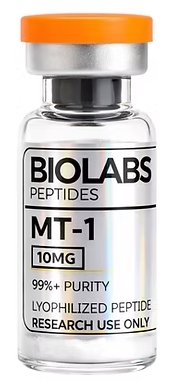
Melanotan-1 (MT-1) is a synthetic, linear peptide analogue of the naturally occurring alpha-melanocyte-stimulating hormone ($\alpha$-MSH). It acts as a potent, non-selective agonist of the melanocortin receptors, with a particularly high affinity for the MC1 receptor found on melanocytes. Unlike the natural hormone, MT-1 is modified with norleucine and D-phenylalanine to enhance its half-life and stability against enzymatic degradation. In research, it is primarily studied for its ability to induce systemic skin tanning (melanogenesis) independently of UV exposure, thereby providing a biological shield against sunlight-induced DNA damage. Since 2019, its pharmaceutical version, Afamelanotide, has been utilized for treating rare light-intolerance disorders.

Reviews
There are no reviews yet.